

How Auto Transport Companies Work
You call a number, describe your car, get a price, and a week later a truck shows up. What happens in between is invisible, and that invisibility is where most customer confusion and most industry tricks live.
Auto transport companies are not mysterious once you see the machinery. There are brokers, carriers, dispatchers, load boards, and drivers, and your car passes through most of these hands on a typical shipment.
This guide opens up the whole operation. You will see who does what, where your money goes, and how to use that knowledge to get a better outcome.
The Two Business Models
Almost every auto transport company is either a broker or a carrier, and many customers never learn which one they hired. A carrier owns trucks and employs drivers. A broker sells the shipment and hires a carrier to perform it.
Most of the companies you find through search ads are brokers. They have the marketing budgets and the sales teams. Carriers tend to be smaller operations focused on driving rather than advertising.
Neither model is a scam and neither is automatically superior. What matters is that you know which one you are dealing with, because it changes who is accountable and how your price is built.
The Broker’s Operation
A broker’s office is phones, computers, and software. Salespeople take your order and quote a price. Dispatchers then post your vehicle on national load boards, which are marketplaces where carriers look for freight to haul.
The dispatcher sets a carrier pay amount, usually your total price minus the broker’s fee, and waits for a carrier to accept. On popular lanes this can take hours. On odd routes it can take days.
Once a carrier accepts, the broker confirms the pickup window with you, passes the driver’s contact info, and stays as your point of contact through delivery. If problems arise, the broker is supposed to intervene.
The broker’s fee, typically $100 to $250 per vehicle, pays for this coordination plus the sales and vetting work. Whether it is worth it depends entirely on how well the broker performs these jobs.
You can judge that worth by asking what the fee covers on your specific shipment. Carrier vetting, load board posting, pickup coordination, and problem handling are the real jobs. If the broker cannot describe what they do beyond taking your order, the fee is paying for a phone call, not a service.
The Carrier’s Operation
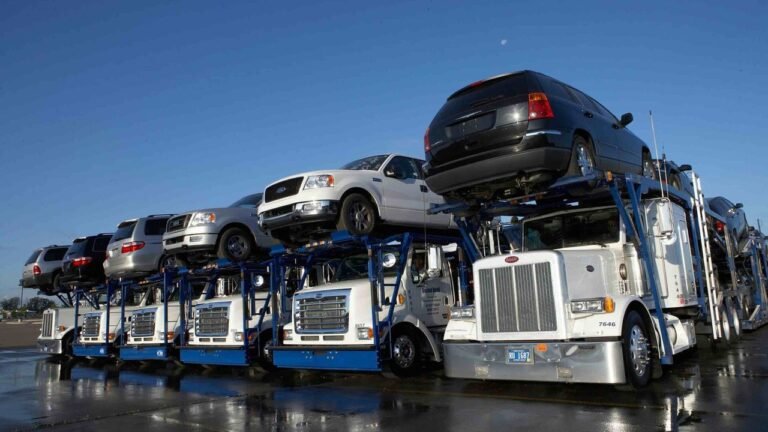
A carrier’s world is diesel, deadlines, and deck space. A typical open carrier holds 7 to 10 vehicles, and every spot has to pay for itself on every run. The dispatcher or owner operator plans routes to keep the trailer full in both directions.
Drivers inspect and load each vehicle, secure it with straps and wheel chocks, and document its condition on the bill of lading. That inspection paperwork is the most important document in your shipment.
On the road, the driver manages a multi stop route, sometimes a dozen pickups and deliveries across several states. Your pickup window depends on where you fall in that sequence, which is why exact times are rare.
Carriers live on thin margins and tight schedules. Understanding that helps you interpret everything from pickup windows to why the driver cannot always reach your exact street.
Load Boards: The Hidden Marketplace
Load boards are the industry’s central exchanges, where brokers post vehicles needing transport and carriers pick the loads that fit their routes. Most customers never see them, but they set the real market price.
When a broker quotes you $1,200, the dispatcher is really asking whether a carrier will take your car for, say, $950. If yes, the broker keeps the difference. If no carrier bites, your car sits until the broker raises the carrier pay or asks you for more money.
This is the mechanism behind the classic lowball. The broker quotes low to win your deposit, posts carrier pay too low to attract a driver, and then calls you with a price increase once you are committed.
You cannot access load boards as a customer, but you can ask the broker what carrier pay they posted. An honest answer tells you the load is real. Evasion tells you the opposite.
Watch out for the pricing games this system enables. Our car shipping scams guide covers the common ones and how to dodge them.
Where Your Money Goes
On a typical $1,200 brokered shipment, roughly $950 to $1,050 goes to the carrier. That covers driver pay, fuel, truck wear, insurance, and the carrier’s overhead. The remaining $150 to $250 is the broker’s fee.
Fuel is the most visible cost driver. A loaded hauler gets 5 to 7 miles per gallon of diesel, so a 2,000 mile trip burns around 350 gallons. When diesel prices move, quotes follow within weeks.
That lag is why quotes have expiration dates. A quote built on last month’s diesel price may not hold if fuel jumps before your car ships. Ask how long your quote is locked and what happens if costs move in between, so a fuel spike does not become a surprise fee.
Driver pay is the largest single cost. Experienced auto transport drivers earn solid salaries, and that pay is spread across every vehicle on the trailer. This is why full trailers mean better prices.
Insurance, compliance staff, dispatch software, and office overhead make up the rest. None of it is glamorous, but it is all real, and it is why rock bottom prices usually mean something is being skipped.
The per mile math behind these numbers is explained in our cost per mile breakdown.
How Companies Find Customers
Most brokers spend heavily on search ads and lead generation. When you fill out a quote form on a generic looking site, your details are often sold to multiple brokers, which is why the phone calls start within minutes.
This lead economy shapes company behavior. A broker that paid $50 for your lead needs to close you fast, which is where pressure tactics come from. The urgency is about their acquisition cost, not your shipment.
Carriers find work differently. They watch load boards, build relationships with reliable brokers, and develop repeat lanes. A carrier with steady broker relationships does not need to advertise to you at all.
Knowing this helps you read the sales process. Aggressive follow up after a quote request is normal in this industry, but it is marketing pressure, not market reality.
For an independent look at what vehicles actually cost to move, Cars.com publishes consumer focused auto transport content alongside its marketplace listings.
Regulation and Oversight
The FMCSA regulates interstate auto transport. Brokers must hold broker authority and carriers must hold carrier authority, and both are searchable in the FMCSA database along with insurance status.
Carriers must also carry cargo insurance meeting federal minimums, and reputable ones carry far more. This insurance is your real protection, more than any promise on a company website.
Enforcement is complaint driven more than proactive. The system works best when customers verify licenses upfront and file complaints when companies misbehave, which is why your own diligence matters.
State regulations add another layer for intrastate moves, but the FMCSA framework covers the vast majority of shipments, which cross state lines.
How Deposits and Payments Normally Work
Payment in auto transport usually happens in two parts. A deposit goes to the broker when your order is confirmed or when a carrier accepts your load, and the remaining balance goes to the carrier at pickup or delivery. Knowing this split helps you spot anything unusual.
The deposit is the broker’s fee in most cases. Reputable brokers charge it only after a carrier is assigned, or take a small refundable amount upfront. A large non refundable deposit demanded before any carrier accepts your load is one of the industry’s classic warning signs, since it removes the broker’s incentive to find you a good carrier.
The balance typically goes directly to the driver or carrier, not the broker. Cash, cashier’s checks, and money orders are the most common methods, because card processing fees eat into thin carrier margins. Confirm the accepted payment methods before pickup day, and have the payment ready in the right form so pickup goes smoothly.
Never pay the full balance before you inspect your car at delivery. Walk around the vehicle with the driver, compare its condition to the pickup bill of lading, and note any new damage before money changes hands. Once you pay in full, your leverage in a damage dispute drops sharply.
Get every payment term in writing: the deposit amount, when it is charged, whether it is refundable, who receives the balance, and how. Legitimate companies state all of this in the contract without hesitation. If payment terms are vague or verbal only, treat that as a red flag and keep shopping, and read our car shipping scams guide to see how those payment tricks are structured.
Frequently Asked Questions
Do auto transport companies own their trucks?
Carriers do, brokers do not. Most companies you find online are brokers that hire carriers through load boards. Ask directly which one you are talking to, and verify the answer against their FMCSA authority record.
Why did my broker not know which carrier would pick up my car?
Because brokers often do not assign a carrier until days before pickup, when they see which trucks are running your lane. This is normal, but the broker should give you the carrier’s name, MC number, and driver contact before pickup day.
How do companies make money on my shipment?
Brokers keep the spread between your price and the carrier pay, typically $100 to $250. Carriers earn the transport fee minus their operating costs. Understanding this split helps you spot quotes where the carrier pay is too low to attract a driver.
What is the cheapest type of company to book with?
There is no universally cheapest type. Direct carriers can be cheaper on their regular lanes, while brokers can be cheaper on odd routes through carrier competition. Our cheapest car shipping companies guide and auto shipping basics explain how to compare fairly.
How long does the whole process take?
Booking to delivery typically runs one to three weeks. Allow a few days to a week for carrier assignment, then transit time based on distance: roughly 1 to 2 days per 500 miles. See cross country shipping costs for timing on the longest routes.
When do I pay the driver?
The balance is usually due at pickup or delivery, paid directly to the carrier by cash, cashier’s check, or money order. Confirm the method and timing before pickup day so you are not scrambling. Always inspect the car against the bill of lading before you hand over payment.
Is my deposit refundable if I cancel?
It depends on the contract, which is why you should read the cancellation clause before paying anything. Reputable brokers refund the deposit if no carrier was assigned, or allow cancellation within a stated window. Get the refund terms in writing and keep a copy.
Why do some carriers refuse credit cards for the balance?
Card processing fees take a real bite out of thin carrier margins, and drivers on the road need guaranteed funds. Cashier’s checks and money orders are the industry standard for the balance. If a carrier demands cash only and offers no receipt, that is a red flag worth walking away over.
Auto transport companies are not black boxes. Brokers coordinate, carriers haul, load boards set the price, and your money splits between them.
Once you see the machinery, the sales tactics lose their power. You know what questions to ask, what answers to expect, and when to walk away.





One Comment