

How Car Shipping Works
From the outside, car shipping looks like a black box. You get a quote, a truck shows up, and your car appears across the country a week later. What happens in between is actually a well-worn process.
This is the end to end walkthrough: quote, booking, dispatch, pickup, transit, and delivery. Knowing each stage helps you spot problems early and understand what is normal and what is not.
Nothing here requires insider knowledge. It is just the sequence of events that every shipment follows, explained plainly.
Stage 1: The Quote
Everything starts with a quote. You provide your pickup and delivery locations, vehicle details, and dates, and the company gives you a price range. Most quotes are ranges rather than fixed numbers because the final rate depends on carrier availability. Most companies respond within a few business hours, though some take up to a full day. A quote that arrives in minutes with a suspiciously low number deserves skepticism. Real pricing requires someone to check current load board rates for your specific route.
Behind the scenes, the price reflects what carriers are currently accepting for similar loads. Brokers watch the national load boards constantly and know the going rate for your route the way a stockbroker knows a share price.
This is why quotes vary between companies. Each broker has its own read on the market, its own carrier relationships, and its own margin. Three to five quotes reveal the true range quickly.
Learn to read quotes critically with our comparing car shipping quotes guide. The cheapest number is often the least honest one.
Stage 2: Booking and Dispatch
When you accept a quote, you typically pay a small deposit and sign an agreement. The agreement should spell out the service type, the price, the pickup window, the cancellation terms, and what happens if the price changes.
After booking, the broker posts your vehicle on the national load boards. These are marketplaces where carriers browse available loads and pick the ones that fit their routes and schedules.
Dispatch is the moment a carrier accepts your load. The broker confirms the carrier’s details with you: company name, driver contact, and an estimated pickup window. This is when your shipment becomes real rather than theoretical.
A reputable broker assigns a carrier at or near your quoted price. If days pass with no carrier accepting the load, the quoted price was probably too low, and an honest broker will tell you so rather than stalling. An underpriced quote has an industry name, the lowball, and it is the single most common complaint in auto transport. Reputable brokers would rather lose your booking than strand your vehicle. If four quotes cluster around $1,100 and one company offers $700, that gap tells you everything you need to know.
Stage 3: Pickup
The driver calls you a few hours before arrival to confirm the meeting point. Car carriers are large, so the exact pickup spot is often a nearby parking lot or wide street rather than your driveway.
You and the driver inspect the car together and record its condition on the bill of lading. Every existing scratch, dent, and chip gets noted. Both of you sign, and you keep a copy. This document is the foundation of everything that follows.
The driver loads your car onto the trailer, securing it with straps or chains over the wheels. Loading a full trailer takes time, so the driver may spend a while positioning vehicles for the right weight balance.
Before the truck leaves, save the driver’s phone number. For the rest of the trip, that number is your direct line for updates. The FMCSA requires carriers to follow hours-of-service rules, so do not expect middle-of-the-night responses, but drivers are generally reachable during the day.
Stage 4: Transit
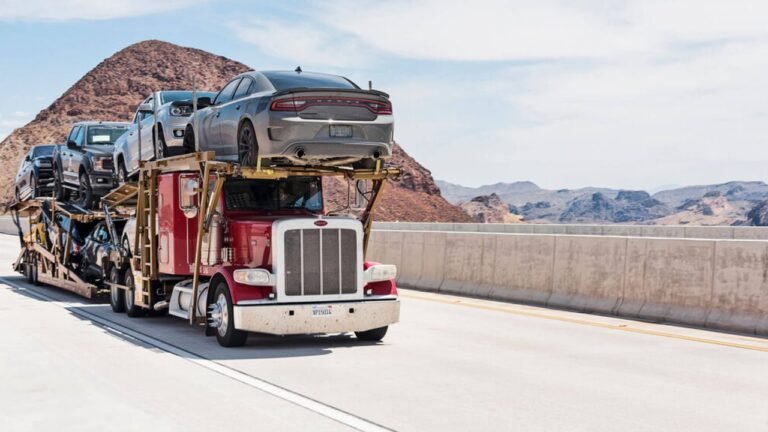
Your car is now one of up to ten vehicles on the trailer, and the driver is working a planned route with multiple pickups and deliveries. The truck does not drive straight from your pickup to your delivery. It follows an efficient sequence.
This is why transit times are ranges. A 1,000 mile trip might take 2 to 4 days, not because the driving takes that long, but because your car shares the truck with other shipments in a sensible order.
During transit, your car is covered by the carrier’s cargo insurance. Nothing is required from you except patience and occasional communication. If the schedule shifts because of weather or traffic, the driver or dispatcher will let you know.
You can generally text or call the driver for a status update. Some larger carriers offer GPS tracking, but the driver’s phone remains the most common tracking method in the industry.
Stage 5: Delivery
The driver calls ahead to arrange the delivery meeting, usually a few hours out. As with pickup, the exact spot may be a nearby lot if the truck cannot reach your address.
Inspect the car before you sign anything. Walk around it in daylight, compare it against the pickup bill of lading and your own photos, and check the odometer. The reading should be essentially unchanged, since the car rode the trailer rather than being driven. Use your phone flashlight even in daylight, since dents hide in shadows and glare. Compare panel by panel against your pickup photos rather than trusting your memory. If everything matches, sign and the shipment is done.
If you find new damage, note it on the bill of lading before signing and photograph it. Then contact the broker or carrier immediately to begin the claims process. This is uncommon, and the paperwork is what makes claims work when it happens.
Pay the remaining balance by the agreed method, take your copy of the signed delivery receipt, and the shipment is complete. Most deliveries are uneventful and take only minutes.
What Can Go Wrong (and How It Gets Fixed)
Pickup delays
The most common hiccup is a pickup that slips by a day or two. This usually means the broker is still finding a carrier at your price, or the assigned truck hit delays on an earlier stop. Stay in contact with the broker and ask for straight answers about the timeline.
Price increases
Sometimes a broker comes back asking for more money after booking. This happens when the original quote was too low to attract a carrier. A reputable company explains the situation and gives you the choice. A bad one pressures you. Know which one you are dealing with before you book.
Delivery delays
Weather, traffic, mechanical issues, and multi-stop routes can all push delivery back. Build buffer days into your plans, especially around flights or move-in dates. Expedited shipping exists for genuinely urgent needs, but it costs considerably more.
The FTC’s consumer resources include guidance on dealing with transportation service disputes, which is worth knowing about even though most shipments never need it.
How Long the Whole Thing Takes
From booking to delivery, plan on two to four weeks for a typical shipment. That includes one to three weeks of lead time before pickup and the transit time itself.
Transit time by distance runs roughly like this: under 500 miles takes 1 to 3 days, 500 to 1,500 miles takes 3 to 5 days, and 1,500 to 2,500 miles takes 5 to 8 days. Coast to coast runs of 2,500 miles or more take 7 to 10 days.
These are working estimates, not promises. The pickup window adds variability on the front end, and route conditions add it during transit. For more detail, see how long car shipping takes.
What It Costs
A running sedan on an open carrier typically costs $550 to $1,800 depending on distance. That range covers the vast majority of consumer shipments in 2026.
The price you pay flows through a simple chain. You pay the broker, the broker pays the carrier, and the difference is the broker’s margin for arranging everything. Understanding this chain explains why the lowest quote is not always the real price.
See how much it costs to ship a car for the full pricing picture, and what is auto transport if any of the industry terms are unfamiliar.
How Timing Affects Your Price
When you ship matters almost as much as where you ship. Summer and January are the peak seasons, driven by family moves and snowbird relocations, and prices on popular routes typically run 15 to 25 percent above the yearly average. The spring and fall shoulder seasons usually bring lower quotes and faster carrier assignment.
Lead time is the lever you control most directly. Booking two to three weeks out gives the broker room to match your load with a carrier already running your route, which keeps pricing competitive. Last minute bookings force higher posted rates to attract a carrier quickly.
True expedited service can add 30 percent or more to a standard quote. Run your dates through a car shipping cost calculator to see how timing shifts the number for your route.
Flexibility on pickup dates is worth real money. A pickup window of three to five days lets the broker wait for the best carrier match, while a single-day requirement narrows the field and raises the price. If your schedule allows any give, say so when you request quotes.
One more calendar effect works in your favor. Routes running against the seasonal flow can be bargains, because a carrier that just delivered snowbird cars south in January needs a northbound load, and your vehicle fills it. Asking about backhaul pricing costs nothing and sometimes saves a few hundred dollars.
Frequently Asked Questions
How does car shipping work step by step?
You get quotes, book with a company, and the broker posts your car to load boards where carriers accept it. The driver picks up your car after a joint inspection, transports it on a multi-car trailer, and delivers it after a second inspection. You pay a deposit at booking and the balance on delivery.
Will my car be driven or trailered?
Trailered. Your car rides on the carrier and the odometer should barely change between pickup and delivery. The only exception is a driveaway service, where someone drives your car to its destination, which is a different service entirely.
How do I track my car during shipping?
Call or text the driver directly using the number you saved at pickup. Most tracking in this industry is a phone call, not an app. Some larger carriers offer GPS tracking, but driver contact is the standard method.
What paperwork do I need?
Have your registration, proof of insurance, and photo ID ready. The key document is the bill of lading, which the driver brings. It records your car’s condition at pickup and delivery, and both parties sign it each time.
What happens if my car is damaged?
Note the damage on the bill of lading at delivery before signing, photograph it, and file a claim with the carrier promptly. The carrier’s cargo insurance covers valid claims. Damage is rare, and thorough pickup documentation is what protects you.
How far in advance should I book car shipping?
Two to three weeks ahead is ideal for a standard shipment. That window gives the broker time to find a carrier at a fair rate without rush pricing. If your dates are rigid or you need enclosed transport, add another week of lead time.
Can I put personal items in my car during transport?
Most carriers allow up to 100 pounds in the trunk, stored below the window line, but those items ride without insurance coverage. Electronics, valuables, and important documents should travel with you. Some carriers prohibit personal items entirely, so confirm the policy before loading anything.
What if nobody is available when the driver arrives?
You can designate someone else to release or receive the car, and most companies allow this with advance notice. That person should carry photo ID and know to inspect the vehicle and sign the bill of lading. Missed appointments can trigger storage or redelivery fees, so communicate early if your plans change.
That is the whole machine, from quote to delivery. It is a mature industry with a standard process, and once you have seen it run, the mystery disappears. For the hands-on version, walk through how to ship a car step by step, or read about the driveaway service alternative if trailering is not what you need.



6 Comments